Riyadh Daily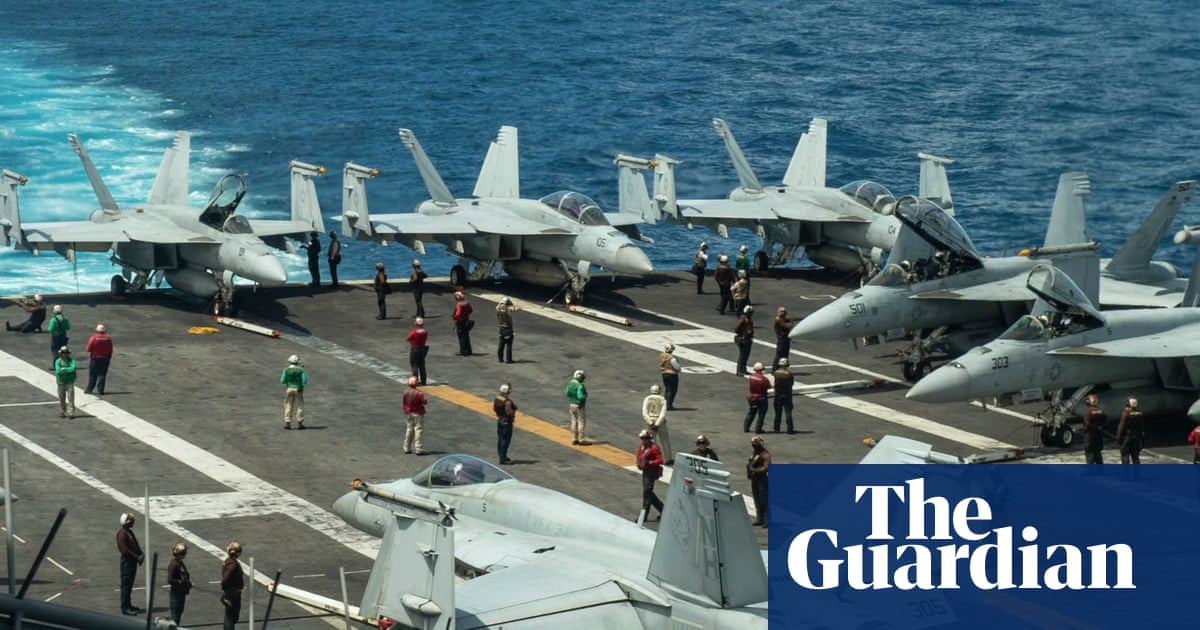
The US military is dispatching a third aircraft carrier strike group to the Middle East, as President Donald Trump warned new strikes against Iran could be on the horizon. The deployment, which includes a specialist amphibious attack group, underscores the rapidly evolving dynamic of Trump’s war against Iran as midterm elections in the US loom large. Trump has threatened that a post-midterm election escalation remains a viable option – despite his initial promises that the war would last a matter of weeks.
The group of ships now en route to the Middle East together carry more than 7,000 sailors and 2,000 Marines. It includes the USS Theodore Roosevelt carrier strike group and the USS Makin Island amphibious readiness group, with its two amphibious landing ships. It could mean that three carriers are in the region as early as the end of October, according to a US official, who spoke on condition of anonymity to discuss sensitive military operations.
Given the personnel already in place in the Middle East, the move would bring the US naval presence to an unusually high number of more than 20,000 sailors and Marines as well as hundreds of aircraft. The Navy previously had three carrier strike groups in the Middle East in April for the first time since 2003. The carriers USS George HW Bush and the USS George Washington are in the region now, along with the USS Boxer amphibious readiness group.
The Washington is typically deployed to the Pacific Ocean, but it was moved to the Middle East to relieve the USS Abraham Lincoln, whose arduous deployment resulted in the crew being at sea for more than 260 days straight . It is possible the Washington could move to seas off Japan, once the Theodore Roosevelt carrier strike group arrives. In a Time magazine interview published on Thursday, Trump raised the prospects of new strikes, saying it is “possible” that he will ramp up bombing in Iran after the 3 November midterm elections.
When pressed, Trump said he could not go into further detail about his strategy. “I can’t tell you that because look, you know, you’re asking, where are you going to bomb?” Trump said. He said in the interview, conducted Monday, that he rejected the latest ceasefire proposal from Iran because “things that I wouldn’t have approved a year ago I wouldn’t have today.” Trump cited as an example an offer from Iran to “open up” the strait of Hormuz , the key energy shipping corridor, but said the overall proposal was “not good enough” .
Asked if the increasingly unpopular war would threaten Republican party chances in November, Trump at first responded: “It’s possible.” But then he added, “It should help, because Iran will not have a nuclear weapon.” The president said “100% of the people” oppose Iran having nuclear attack capabilities “including worldwide”. “So, when you say it that way, it would help,” Trump added. “If you don’t say that, it could hurt.”
Source: The Guardian