Riyadh Daily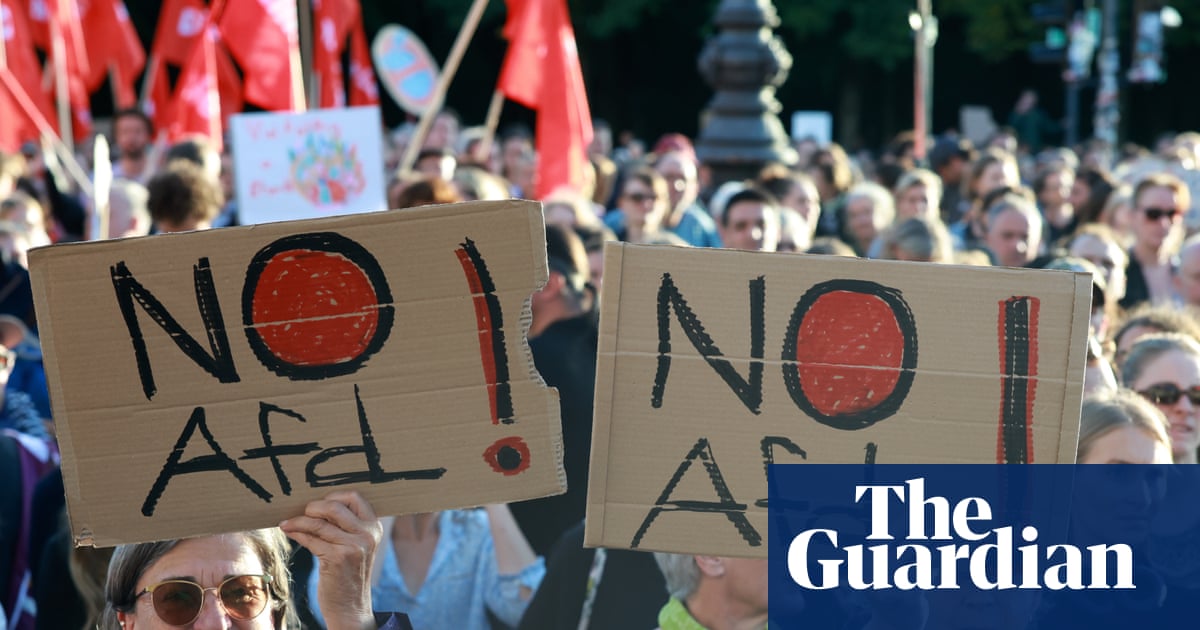
Thousands of Germans have staged protests against the far-right Alternative für Deutschland (AfD) after its watershed victory in a state election, warning it poses a danger in two more polls this month. Demonstrators at Berlin’s Brandenburg Gate held a peaceful pro-democracy rally denouncing the anti-immigrant, pro-Russian AfD, which has called for mass deportations of asylum seekers and a rollback of state support for renewable energy and public broadcasting.
The party captured its best-ever state result in the former communist eastern state of Saxony-Anhalt on Sunday, with clear momentum heading into regional elections in the capital and Mecklenburg-Western Pomerania on 20 September. Police reported 5,000 protesters, while organizers said they drew more than 14,000 people in a campaign to mobilize voters against the AfD. Posters in the crowd read ‘Fascism is no alternative’, ‘Stop the Nazi AfD: end racism and cuts to social services’, and ‘History has its eyes on us’.
With less than two weeks to election day, demonstrators cautioned against resignation and cynicism after Sunday’s shock result. The AfD’s nearly 44% vote in Saxony-Anhalt, the best for a nativist party since the Nazi period, is a ‘disgrace that makes you furious and stunned’, said Jens-Christian Wagner, director of the memorial at the former Nazi concentration camp Buchenwald. Protesters thronged the roads around Brandenburg Gate, Berlin, on Monday after the AfD victory. Wagner warned the AfD, though it fell just short of an absolute majority, was on the brink of taking power in Saxony-Anhalt, a first for the far right since World War II.
Max Schneller, 17, a member of the far-left Linke from Saxony-Anhalt, said activists would fight any attempts by an AfD government to target minorities. ‘We will not start categorizing our neighbors according to their origin, religion, or skin color – we are too humane to hate,’ he said to loud applause.
The AfD is three votes short of the support necessary to form a government under its candidate, the media-savvy firebrand Ulrich Siegmund, who hopes to peel off dissenters from the remaining parties willing to play kingmaker. Germany’s domestic intelligence agency has since 2023 listed the state chapter of the party as right-wing extremist, posing a threat to democratic norms.
Hundreds of anti-AfD protesters also gathered in Potsdam, near Berlin, with rallies organized in Münster, Göttingen, Dresden, Aachen, Bamberg, Darmstadt, and Halberstadt in Saxony-Anhalt, where the AfD captured nearly half the votes, local media reported. In Halle, the region’s second-largest city, leftist groups and civil society organizations have staged a protest camp since election day.
The AfD is leading in voter intent polls in Mecklenburg-Western Pomerania, with about 35%. However, the center-left Social Democratic Party (SPD) of the state premier, Manuela Schwesig, mounted a remarkable comeback over the summer and is now scoring above 30%. In Berlin, one of Germany’s 16 federal states, the picture is more mixed, with several parties jockeying for first place. The CDU, led by Chancellor Friedrich Merz, holds a wafer-thin lead in the capital, with about 20%, followed by the Linke, AfD, SPD, and Greens, all polling in the mid-teens.
Merz has vowed to stay in office and fight for a signature package of painful reforms, arguing the only way to defeat the AfD is to revive Europe’s top economy and repair its creaking social welfare system. However, the SPD has indicated it may backtrack on some unpopular measures to shore up support for the embattled government, potentially destabilizing the coalition further.
Source: The Guardian